Showing posts with label RSS. Show all posts

Friday, July 25, 2025

Dhankar, RSS and Retirement

The resignation of Vice President Jagdeep Dhankar, the country’s second highest Constitutional functionary, hardly seemed to have created a crisis or even a political controversy. Prime Minister Narendra Modi set out on his foreign jaunts as if nothing significant had happened and the signing of the trade deal with the UK on Thursday soon pushed Dhankar out of the top news headlines.

There is doubt about Dhankar really suffering from a debilitating disease that deters him from chairing the Rajya Sabha or holding his office. Political pundits have latched on to the theory of Dhankar defying the BJP leadership in accepting a notice of impeachment of Justice Yashwant Varma by the Opposition as the reason for the government losing its faith in him. This, sure, is better than the official ill-health theory but still falls far short in the realm of possibilities.

A strong government that can without demur ease out a Constitutional functionary can also politely ask him or her to toe the line. There is no need for a person holding a high office to resign, that too during the Parliament session, if it were merely a case of difference of opinion about accepting a notice ahead of the Lok Sabha proceedings. Dhankar’s resignation smacks of a much bigger political plot. In fact, this is one of the bigger crises that Modi has tackled in his 11 years as Prime Minister.

Yet, the resignation has not rocked the boat as most resignations even from far more insignificant roles are wont to in this era of social media omnipresence. Four days have passed after Dhankar’s resignation; but he has not made a statement or anonymously leaked out a story in the press on what exactly transpired between him and the government.

Such unprecedent control over political messaging even during a high-profile political exit is rare and has been the hallmark of Modi’s tenure. But it has triggered an intense debate on a vital issue: the Modi-RSS relationship. Dhankar and Modi are 74 and the latter will be 75 --- the unofficial retirement age --- in a month and a half.

Dhankar’s resignation has made the Delhi commentariat wonder whether it has anything to do with RSS Sarsanghachalak Mohan Bhagwat earlier this month reminding the Sangh Parivar organisations, which include the BJP, that leaders ideally ought to retire at 75. Soon a former RSS spokesperson wrote an op-ed clarifying that it was not meant for the PM’s consumption and was a piece of general advice to the society at large.

However, Bhagwat has not made any such clarification yet. He may even shock the organisation and step down as he turns 75, six days before Modi does so. Sure, it is too close to the event and there are no signs yet of a successor getting groomed. So, all this could be mere pressure tactics as well. But Bhagwat’s recalling of Moropant Pingle’s advice on an age limit for public servants has suddenly opened up the fault lines that existed between the PM and the mother ship.

Unlike Vajpayee, who visited the RSS headquarters in 2000 within three years of becoming Prime Minister –– even while steering a tough coalition of constantly bickering allies –– Modi waited 11 years for this crucial visit. Modi was the first RSS Swayamsevak to lead the BJP to a simple majority in Parliament and head a government without the crutches of the alliance partners.

Yet, it was only after he fell short of simple majority in the 2024 polls and was forced to depend on the allies to form a government that he decided to visit the RSS headquarters in March 2025. Earlier during the inauguration of the Ram temple, Bhagwat was made a mere spectator while Modi presided over the priestly proceedings. The not-so-warm vibes between these two icons of the Sangh Parivar were on public display at Ayodhya in January 2024 and at Nagpur in March 2025.

Still, no Parivar insider envisages a change of guard at the Raisina Hill before 2029, if at all. The RSS appreciates all that the BJP has done for the organisation and understands the pitfalls of pushing its own government out of power as it happened in 2004. Dattopant Thengadi, the most credible RSS leader, probably more popular than the then RSS chief KS Sudarshan, had held a rally at Ram Lila Maidan and attacked the Vajpayee government viciously in 2001.

There will be no such public exhibition of sibling rivalry or maternal disappointment this time around. Yet, the fact that the BJP still has not chosen a new party president proves that there are points of friction between the two power centres in the Sangh Parivar that are not allowing a consensus candidate to emerge. Even Dhankar’s exit is being framed in an organisational paradigm –– an outsider who was showered with opportunities finally becoming a disappointment.

Like Dhankar, many of the new BJP’s top leaders have come from either Congress or other Opposition parties. This has irked the RSS to no end. And the loss of majority for the BJP in the 2024 elections has emboldened the RSS leadership to point out that the party is only a part of the Hindutva family. The results once again underscored the old organisational hierarchy and negated former party president JP Nadda’s claim that BJP is “capable” of running its affairs.

No wonder there was much speculation around Uttar Pradesh Chief Minister Yogi Adityanath’s meeting with the Prime Minister last week. But all the talk about succession planning seems premature. Sure, there would be a shakeup with a new Vice President and party president offering signposts for the BJP’s future.

Till Leader of Opposition Rahul Gandhi keeps on pledging to purge the RSS, the PM has nothing to worry, because it becomes imperative for the RSS to support a strong leader who can keep its enemies at bay. But the moment the organisation finds a support base elsewhere the situation can get altered dramatically. Then, few contemporary Indian politicians are equipped to play such nuanced strokes of power politics like Modi.


Monday, February 1, 2016

Why bypass due process of law to term Rohith non-Dalit?


Polibelly/Economic Times
February 1, 2016
Rajesh Ramachandran
It doesn’t make any sense for BJP to accuse the family of Rohith Vemula of forging a caste certificate. Rohith is a victim of our academic system, political interference and campus rivalry. His victimhood does not get altered because he was pitted against ABVP. By claiming that Rohith was not a Dalit, the BJP leadership is questioning the victim’s integrity and terming the family frauds.
This political strategy can only further alienate from BJP those who are grieving for Rohith. 
There is a legitimate method to probe whether a caste certificate is genuine or not. The government of Andhra Pradesh can ask the district collector of Guntur to verify the caste certificate issued to Rohith. The district collector after hearing Rohith’s family can present his findings to the government, which at the highest level can decide to set aside Rohith’s caste certificate. There are guidelines for issuing, questioning and cancelling caste certificates, endorsed by the Supreme Court.
BJP is bypassing this due process of law to jump into a conclusion based on some secret police reports, why? It seems BJP believes that if Rohith is proven to be a non-Dalit, the issue will lose its political gravitas. Well, every unlettered Dalit is aware of the threat of an enquiry into his or her caste certificate. It is but natural for a desperate Dalit to hide his caste to escape oppression and then to reveal it to get governmental benefits. 
So, an attack on Rohith’s caste certificate will make ordinary Dalilts bristle because the only identity that Rohith held dear as a student was that of an Ambedkarite. As a meritorious student who did not use his caste certificate to get into the University of Hyderabad, he had the option of calling himself an OBC Vaddera as his estranged father was a Vaddera. But he chose to uphold the Dalit Mala identity of his mother. An offspring of a mixed marriage, Rohith could have got his caste certificate because he was brought up in a Mala neighbourhood as a Mala. 
Whatever be the reason, Rohith chose to be a Dalit and an Ambedkarite. Sure, there are non-Dalit Ambedkarites, but in this caste-ridden society no non-Dalit would want to be called a Dalit. When Rohith calls himself a Dalit, without using or misusing his caste certificate, he has every right to his identity. For someone from the lowest stratum of the society, there is nothing to be proud about being an outcast. Only burning idealism could have turned him into a fullfledged Ambedkarite. 
Forget for a second Rohith was a Dalit. There cannot be any argument over his identity as an Ambedkarite and that is the most potent political label for a Dalit. BJP should understand that it is not reassuring the Dalit masses by questioning the dead student’s caste and by challenging an Ambedkarite’s identity. The BJP leadership, instead of taking on its political rival, Rahul Gandhi, is wasting its time targeting Rohith.
http://epaperbeta.timesofindia.com/index.aspx?eid=31815&dt=20160201

Rohith as a Dalit Metaphor


Sunday ET
January 24, 2016
Rajesh Ramachandran
Campus politics rarely impacts the larger world outside. Over the years, agitational politics of Jawaharlal Nehru University ( JNU) and other central universities could not influence mass politics or become electoral determinants. Even the much-lamented murder of JNU students' leader Chandrashekhar Prasad in 1997 could not turn the tide of caste politics in Bihar. But the unfortunate suicide of Rohith Vemula has the potential to change the dynamics of Dalit politics.
Food for Thought
ABVP, sure, is a political outfit. But Ambedkar Students' Association (ASA) is not. It is a congregation of Dalit students who come together to fight discrimination and oppression within campuses. Old-timers of Hyderabad's universities remember how the first amorphous Dalit group fought for its right to be served food along with the upper castes.
In fact, one of their first political acts was to support the Mandal commission recommendations for other backward classes (OBC) reservation, though they did not benefit from them. Now, the ASA is a potent body that pursues radical politics along with Dalit empowerment. But its members do not necessarily have a political affiliation. For instance, Rohith started off as a Marxist and turned a bitter critic of his old party, Communist Party of India (Marxist). Most of his colleagues from ASA have been articulating views critical of all the mainstream parties. They are primarily Ambedkarites and so will never challenge Ambedkar's role in drafting the Constitution or promote a philosophy that demeans the Constitutional institutions of the country.
An Ambedkarite by definition cannot seek to overthrow the Constitution. So, it may be counter-productive for the BJP and the Sangh Parivar to dub the Ambedkarites anti-national. Students do take radical positions to be intellectually fashionable in campuses and this need not be held against them by seasoned politicians and members of Parliament. The political leadership should not act prickly about a protest march against death penalty or a beef festival.
Unlike upper caste radicals of JNU and elsewhere who would happily wear the anti-national label on their sleeve as a fashion statement, a Dalit would be scared of losing the prospects of a government job — her only promise to prosperity. This attack on Dalit students could only add to their woes and make them more strident in their opposition to the Sangh Parivar Politically this move by the BJP can only further alienate the Dalit students and their families.
The community is up in arms all across the country. It is as if Rohith has suddenly become a catalyst in radicalising, politicising and energising a community that believes in Ambedkar's dictum that Dalit salvation is through education.
People are flooding the traditional and the new media across the country and across languages with angry articles.
Cause & Effect
No instance of atrocity in the recent past — and there are terrible atrocities committed on Dalits all across the country — has made the community come together like this to express its outrage. This may not get converted into a deluge of votes in favour of one party or the other. Interestingly, every Dalit activist is not even protesting against the Sangh Parivar or the BJP.
In Kerala, a woman Dalit scholar took on the Leftists, exposing their hypocrisy, asking the Marxists why they are supporting Rohith now when they had harassed her earlier in the campus. Another one from Hyderabad used this opportunity to ask why the underground leadership of the Maoists is primarily upper caste. Yet another one quoted Rohith to prove that the CPI(M) has never had a Dalit member in its politburo.
So, Rohith's suicide has triggered a sudden crystalisation of identity politics among Dalits who feel betrayed by the system. This pan-India phenomenon may act out in different ways in various states. It may help Mayawati keep her flock together in Uttar Pradesh or help K Chandrashekhar Rao gain Dalit support in Telangana. But politicians are aware that they need to underscore their support for the Dalit cause. And that explains the visit of Rahul Gandhi and Arvind Kejriwal to Hyderabad soon after the suicide.
Kejriwal is a serious contender in Punjab, where Dalits comprise over 30% of the population and the Aam Aadmi Party hopes to upset the Akali-BJP combine and the Congress in the next polls in 2017. Beyond electoral politics, Dalits all over the country want this incident to act as a sharp reminder to the community that it is time to protect itself from the final pushback from the portals of progress. They know that if they give in now, they will never be equal citizens ever.
http://economictimes.indiatimes.com/news/politics-and-nation/rohith-vemulas-suicide-has-triggered-a-sudden-crystalisation-of-identity-politics-among-dalits-who-feel-betrayed-by-the-system/articleshow/50698953.cms

Tuesday, February 10, 2015

The first story on Advani as Dy PM. May 24, 2001

Parivar wants Advani as deputy PM? By Rajesh Ramachandran
May 24, 2001 
The Times of India News Service 
NEW DELHI: The Sangh Parivar-Prime Minister Vajpayee tension may be heading towards a solution after a series of closed-door meetings and high-level consultations. According to Sangh Parivar sources, the crux of the solution could be the appointment of home minister Advani as the deputy Prime Minister. 
The Parviar hardliners maintain that the deputy PM option is the only one available because any change of leadership at this stage would weaken the government as a whole. A senior Parivar leader, however, said, "It is left entirely to PM Vajpayee to take a decision. Either way, we would honour his decision." Parivar sources suggest that the PM's enforced hospital stay for knee surgery in mid-June could be an opportune moment for the announcement. 
This development comes as a consequence of a series of events since the March 'Armsgate' expose. While the government was attacked by the Opposition, the Sangh Parivar focused its attacks on the PMO. The subtext of the Parivar attacks on Vajpayee's foster son-in-law and principal secretary Brajesh Mishra was the grouse that the PM had strayed too far away from the Sangh Parivar and its ideology. This was followed by the poor performance of the BJP's allies in the recent assembly elections, a factor that has had a negative effect on the government's image. In these circumstances, there has been a growing feeling within the Sangh Parivar that the government's future can be salvaged by making Advani the deputy PM. 
There was some speculation about the PM formally handing over charge to Advani before he went in for his earlier knee surgery. But this did not materialise. This time around, with changes in the political situation, opinion has built up within the Parivar in favour of an image- lift for the government, especially with the assembly polls in Uttar Pradesh scheduled as early as October or latest by March 2002. 
A section of the Parivar also feels that the public perception of Advani as a tough customer could help in redeeming the government's tottering image. More importantly, Ayodhya and Hindutva could still be the rallying points in UP, with the Vishwa Hindu Parishad all set to begin its agitation programme in September. 
"Advani can formally help out the PM. Contrary to rumours, the PM is healthy. He merely needs a strong No 2 who can keep tabs on the administration. Vajpayee will still be the undisputed leader of the NDA, in total control of the government," said a senior Parivar leader. The RSS leadership is wary about making any public comment on the issue. For the record, they maintain that the question of Advani being sworn in as deputy PM never arose during the May 11 luncheon meeting that RSS leaders had with the PM.

Sunday, November 2, 2014

When a climber becomes a banyan tree


http://economictimes.indiatimes.com/news/politics-and-nation/riding-piggy-back-on-local-allies-is-there-a-pattern-to-bjps-growth-across-the-country/articleshow/45006355.cms

My Sunday ET column, November 2, 2014

If the Bharatiya Janata Party (BJP) has to be visualised as a plant, it can best be thought of as a lithe, fast-growing climber that seeks nourishment from the body of an older, bigger, rooted ally, which is part of the local flora. But unlike the climbers of the plant world, the BJP as a political entity replaces its older partner so completely that it doesn't leave a trace of the original body on which it grew.
The first BJP government in Maharashtra is being touted as Prime Minister Narendra Modi's personal achievement. But is the Maharashtra victory due only to Modi's strategic vision and Amit Shah's tactical brilliance or is there a pattern to the BJP's growth across the country, riding piggy-back on local allies?

Political Fillip

Now, it is difficult to imagine Gujarat as a non-Hindutva state. But in the 1971 Parliamentary polls, Congress (O) had about 10 seats, the Swatantra Party one in Gujarat and the Rashtriya Swayamsevak Sangh's (RSS) political outfit, Jana Sangh, had none. Around that time, one of the significant victories against the Congress from Gujarat was that of Maniben Patel, the daughter of Sardar Vallabhai Patel. Despite contesting against Congress, she was not part of Jana Sangh.
The RSS grew as a political entity primarily during the days of the Emergency, bringing all the right-wing forces — its own Jana Sangh, the feudal lords' Swatantra Party, the right wing within the Congress, the Congress (O), and the Socialist bloc — together on the single platform of the new Janata Party. It borrowed the election symbol of Charan Singh's Bharatiya Lok Dal and swept the 1977 Lok Sabha polls.
But when the Janata Party split and the BJP was formed in 1980, there was no Swatantra Party or Congress (O). Instead, the BJP became a bigger entity occupying their space in states where these two parties dominated. After the Janata experiment, the RSS got its next political fillip when VP Singh led his anti-Congress Janata Dal to victory. The BJP got a share in power in Gujarat for the first time in 1990 along with Janata Dal's Chimanbhai Patel, the chief minister who conceived the Narmada dam, the ports and the power plants of the state.

A Footnote in History
Soon, Janata Dal became a footnote in history and most of the party merged with the BJP in Gujarat, turning a minor player into the dominant political force. Many RSS leaders such as Shankersinh Vaghela, Keshubhai Patel, Suresh Mehta and Narendra Modi contributed to this stupendous task of turning Gujarat saffron.
In Rajasthan, too, the Jana Sangh was at best a bit player. The leader of Opposition in the Rajasthan assembly in much of the '60s and the '70s was the state president of the Swatantra Party and the head of the All India Kshatriya Mahasabha, Maharawal Lakshman Singh of Dungarpur. Though Bhairon Singh Shekhawat became the first non-Congress chief minister of Rajasthan in 1977, it still was a Janata Party government.
Even in 1990, he could become the chief minister only with the support of Janata Dal. And it was only after the complete assimilation of the remnants of the Janata Dal, Rajasthan's politics became a contest between the Congress and the Bharatiya Janata Party.
Another example is Karnataka. The first non-Congress chief minister of the state Ramakrishna Hegde, originally from the Congress (O) stock, had sort of inherited his guru S Nijalingappa's support base among the Lingayats of the state.
When Hegde with his Lok Shakti switched sides to support BJP in 1998, the saffron party made an impressive performance winning about 13 seats. Then, it was just a matter of a few years before it grew in stature to share power with Deve Gowda's Janata Dal in 2006 and then to win the assembly polls in 2008.
Is not the story of BJP's growth in Maharashtra similar? The BJP rode the anti-Congress wave in 1989 accepting the leadership of Shiv Sena to gain a foothold in the state. Later, it shared power with Sena in 1995 and now it is a bigger party, primarily because of Sharad Pawar's decision to force a four cornered contest in the state.
Political commentator Kumar Ketkar while agreeing with the Gujarat parallel insists that BJP may not be able to replace its allies to turn Maharashtra into a politically bipolar state like Gujarat or Rajasthan or Karnataka.
“Unlike Gujarat, where trade and commerce are the determining factors, Maharashtra is dependent on farming. The BJP does not have the farmers’ politics in its DNA. The BJP’s success may depend largely on Modi and the longevity of Sharad Pawar’s politics,” said Ketkar.
However long it lasts in Maharashtra, the BJP brand of climber-politics is only expanding its footprint. Next fertile stops are Bengal and Tamil Nadu, where the sisters and mothers of local politics had for long nurtured the saffron seeds.

Tuesday, September 30, 2014

Modi Should Now Sing "Ishwar Allah Tero Naam..."

http://epaperbeta.timesofindia.com/Article.aspx?eid=31816&articlexml=Polibelly-Modi-Should-Now-Sing-Ishwar-Allah-Tero-30092014006018

Polibelly, my ET column

Sep 30 2014 : The Economic Times


Mahatma Gandhi is the nation's moral compass. When an RSS volunteer-turned-Sangh Parivar politician like Prime Minister Narendra Modi appropriates Gandhi at a global stage in New York's Madison Square, the compass itself gets recalibrated: the needle mindlessly swings from the Right to the Left. Impossibly incompatible ideas like Gandhi's pluralistic tolerance and celebration of religious diversity get mixed up with Savarkar's monolithic Hindutva and aggressive assertion of the Hindu identity. Gandhi's killer, Nathuram Godse, had opened an RSS shakha at Ratnagiri where VD Savarkar was interned after writing out an abject apology to the British to escape the cellular jail. Savarkar was a co-conspirator in Godse's plot to kill Gandhi, though acquitted by the trial court and mysteriously let off by the prosecution without an appeal.
Savarkar coined the term Hindutva, theorising that India belonged to only those who revere it as their pitru and punya bhumi (father and holy land), and thereby delegitimising Muslim and Christian citizens.
RSS' political outfits, Jan Sangh or BJP, never professed Gandhian pacifism or ahimsa.Sure, BJP had talked a lot about Gandhian Socialism when it was founded in 1980, without ever really defining what it meant by the term. After BJP assumed power, leading a coalition in 1998 and then in 1999, it shockingly hung the portrait of Savarkar in Parliament's Central Hall. Then home minister, LK Advani, had even got the airport at Port Blair renamed after Savarkar.
Now, there is a complete U-turn by Modi, the biggest political symbol of Hindutva power. After becoming Prime Minister, Modi has never publicly spoken about Savarkar, the RSS founder Hedgewar or its brightest chief ever, Golwalkar. And he has also not stopped speaking about Gandhi. Is there is a shift in RSS and Sangh Parivar ideology? Is there a re-thinking of Hindutva, a refashioning of Hindu identity to accommodate all of this nation's diversity?
It does not seem so. The riots of Western Uttar Pradesh, the hate speeches of certain BJP leaders and their political outcome were still fresh to give traction to the Love Jihad campaign in that state, recently. No official Eid party was held in Lutyens Delhi after Modi became Prime Minister. Even the tokenism of the Muslim cap lies rejected. So, why appropriate Gandhi, who stands accused of fathering political tokenism, minority appeasement, deflating the Indian machismo and much else?
The answer lies in the transformation that Modi seeks. He is already a bigger Hindutva icon than Savarkar and all his disciples, including Advani, put together. Sure, he needed all of them in his journey atop Raisina Hill during which he paid a rich tribute to 15 RSS leaders, including Madhukarrao Bhagwat, RSS chief Mohan Bhagwat's father, in his Gujarati book “Jyotipunj“.
But now Modi wants to shake off his partisan appeal, seeking wider acceptance. And who else but the global messiah of peaceful resistance can offer him the perch of international acceptance? Swatch Bharat, celebrating the centenary of Gandhi's return from South Africa and his 150th birth anniversary are all great markers of India's nationhood, no doubt.But to be seen sincere, Modi should also sing along, “Ishwar, Allah tero naam...“ And for Gandhi this new admirer is no good news. People who call him casteist now will soon call him worse names.

Thursday, March 13, 2014

Princes And The Parivar

Here is a 10-year-old piece that I wrote for The Times of India on the rise of BJP in Central India, riding the princes and their Swatantra Party.

By Rajesh Ramachandran
April 17, 2004
Dance of Democracy, The Times of India
Poll pundits predict BJP victories in Madhya Pradesh, Gujarat, Rajasthan and the tribal belts of Chhattisgarh and Orissa. The BJP’s stranglehold in these areas is often ascribed to the penetration of the RSS and its offshoots like Vanvasi Kalyan Ashram, Vishwa Hindu Parishad and Bharatiya Kisan Sangh.
   The RSS network in this region, though strong, is not the only reason for the BJP’s phenomenal growth. The RSS pracharaks worked on the credibility and the feudal edifice lent to them by the former rulers who promoted the Bharatiya Jan Sangh (BJS) and the BJP.
   Without Dilip Singh Judeo and his father’s active participation there would have been no Vanvasi Kalyan Ashram in Jashpur. The tribal belt is dotted by rulers and jagirdars who were anti-Congress: Bastar, Kanker and Jashpur in Chhattisgarh; Dhenkanal, Kalahandi, Keonjhar, Mayurbhanj and Patna in Orissa; Udaipur, Alwar, Bharatpur, Dholpur (Vasundhara Raje is married to this family), Karauli, Dungarpur, Jhalawar, Kota, Jaipur (of the famous Gayatri Devi), Jodhpur, Bikaner and Jaisalmer in Rajasthan. Gwalior, Rewa, Dhar, Narsinghpur, Satna and their jagirdars in MP all lent their princely status to seek votes for the Swatantra Party, BJS and BJP, as did the princelings of Gujarat.
   The BJS’ early gains were in MP and largely due to the late Rajmata of Gwalior, Vijayaraje Scindia. When she was in Congress in 1962, BJS had three MPs from the state, but after the anti-Congress Bastar prince’s murder, the tide turned and in 1967 there were seven BJS and six BJS-supported independent MPs.
   Vijayaraje’s political advisor Sardar Angre says, “The RSS made progress entirely because of the so-called Samants. Though ideologically affiliated to the Sangh, most princes were nervous about supporting BJS because of the allegations over Gandhi’s assassination. There was a baseless allegation that the revolver used came from Gwalior. And Swantantra was better funded by Bombay’s industrialists. But Rajmata was braver than the rest and joined Jan Sangh while most others opted for Swantantra’’. Ideological distinctions between Swantantra and BJS were blurred. In 1967, Vijayaraje contested for Parliament on a Swatantra ticket and the assembly on a BJS ticket.
   Though exonerated in the Gandhi assassination case, Alwar and Bharatpur princes were under a cloud and the Alwar PM N B Khare later became the Hindu Mahasabha president. It would have been natural for the rulers to align with the new power centre, Congress. Yet, many opted for Swatantra. Angre calls Swatantra a “good stepping stone for rulers and BJS’’. His brother-in-law finance minister Jaswant Singh was in Swatantra, a bigger Opposition party than BJS in Rajasthan, Orissa and Gujarat.
   Angre is clear that without the princes’ help BJP would never have grown into a ruling party: “RSS had influence over princes who influenced people and so BJS and BJP became viable alternatives to Congress.’’
   After Nehru proposed a land ceiling law in 1959, the princes who had their titles, privy purses and land to protect formed the Swatantra Party. It came second in the 1967 LS elections with 44 seats and 8.67% votes, becoming number one in Gujarat (12 seats), Orissa (8) and Mysore (5) and second in Rajasthan (8). After Indira Gandhi nationalised banks and abolished privy purses, Swatantra, BJS, Congress(O) and some socialists formed the Grand Alliance. Of these, only Swatantra fought in Orissa and was ahead of BJS in Rajasthan and Gujarat. In MP alone there were 8 princes under the BJS banner or as BJS-supported independents.
   Today, the sangh parivar no longer depends on princes for its survival in these areas. The anti-conversion campaign has acquired its own momentum and, if anything, the Judeos of the area today need the parivar and its ideology to remain politically relevant. TNN

Saturday, September 14, 2013

The cadre gets who it wants

Rajesh Ramachandran
The Hindu Business Line Edit page, September 14, 2013
http://www.thehindubusinessline.com/opinion/the-cadre-gets-who-it-wants/article5125088.ece#comments

It is not easy for a cadre-based organisation to turn an individual into an issue and fiercely fight for his endorsement by peers and elders. That is exactly what the Rashtriya Swayamsevak Sangh (RSS) leadership has successfully done for Gujarat Chief Minister Narendra Modi’s anointment as the Bharatiya Janata Party’s Prime Ministerial candidate for next year’s Parliamentary polls.
There was no doubt about the disciplined charioteer, L. K. Advani, coming around to accept the choice of Modi, despite issuing a letter of disappointment to party president Rajnath Singh.
Though he remains the tallest leader in the party, in the absence of former Prime Minister Atal Behari Vajpayee due to ill health, Advani’s personal ambitions and arguments against Modi find no resonance within the Sangh Parivar.
True, Modi is divisive, capable of polarising the polity, pushing the Muslim voters to the waiting laps of the Congress; he has used and forgotten the Parivar cadre in Gujarat, even disowning Vishwa Hindu Parishad leaders who made him the “Hindu hridaya samrat”; from BJP leader Sanjay Joshi to former minister Maya Kodnani to former DIG D.G. Vanzara, there are many old friends who have turned foes; he may even push potential allies into forming a khichdi non-Congress-non BJP third front government rather than letting him be Prime Minister.
The Parivar too has analysed all these negative consequences of building up the Modi persona and concluded that one compelling reason is good enough to create, sustain and bank on brand Modi: the RSS cadre and their supporters.
Be it the English speaking NRIs fighting the Sangh battle on social media platforms, the middle classshakha-goer of small towns or the unlettered saffron voter of the Hindi hinterland or the honchos of the corporate world, the Indian Right wants Modi --- and it wants him now.

THE NEW MASCOT
“A curious case of the cadre dictating terms to the leadership,” is how a veteran RSS leader explained the Sangh Parivar’s decision. For some of the RSS workers from Uttar Pradesh who had converged in Delhi for a farmers’ meeting at Ramlila Maidan on Friday, this was an inevitability, which even Advani could have avoided only at the risk of inviting the wrath of the supporters. “The cadre would have laid siege on the BJP HQ had this not happened,” says Virender Singh, former BJP Member of Parliament from Mirzapur in eastern Uttar Pradesh. Now with Modi leading Team BJP, Singh and many others hope the BJP would win 50 out of 80 seats in UP.
This is not the first time the Parivar has been dwarfed by the stature of its own creation. Vajpayee was as much an RSS pracharak as Modi. Though many in the Sangh did not approve of Vajpayee’s carefully crafted image of a moderate leader, no one could ignite the aspirations of the RSS’ core constituency of Brahmin-Bania-Thakur (BBT) votes better than Vajpayee, particularly in Uttar Pradesh.

CASTE ARITHMETIC
If Vajpayee was the electoral mascot for the BJP in 1996, 1998 and 1999, there ought to be yet another leader who can connect with the cadre, force them out of the homes to work for the party to make a difference at the polling booth. Modi becomes crucial for Sangh’s designs as the party looks at signs of revival in Uttar Pradesh, where the BBT vote bank appears restive seeking to return to the BJP fold.
It is indeed strange that it was always a non-Brahmin who created the wave that swept the upper caste votes in the Hindi heartland. Kalyan Singh and Uma Bharti, two leaders from the other backward community (OBC) of Lodh Rajputs, shaped the destiny of the BJP in Uttar Pradesh and Madhya Pradesh and articulated the aspirations of the BBT voters elsewhere.
Probably, the BBT voters feel most reassured when an OBC leadership emerges to safeguard and protect the Hindutva model that includes the pyramidical caste hierarchy. All calculations of BJP achieving the best possible results in the cow belt now are again based on a surge in non-Yadav OBC votes.

CRYSTALLISING EFFECT?
Modi, also from a backward community, has clearly inherited the polarising effect of Kalyan Singh and Uma Bharti, without really sweating it out arousing the masses over decades. And his opponents within the Parivar and the National Democratic Front have termed Modi a liability for his ability to polarise voters along communal lines.
Well, for BBT voters and Sangh supporters, this is not a polarising effect but a “crystallising” effect --- and this cannot be achieved by any other leader talking about secular issues like food, homes, jobs, economic growth or education.
Caste and communal pride refurbish the saffron party’s unique selling proposition. Advani’s Rath Yatra did exactly that, but he was soon done in by the hawala probe, which catapulted Vajpayee to the top.
Advani’s later attempt at moderation in 2005 terming Pakistan founder Mohammed Ali Jinnah “secular” was a disastrous public relations exercise for the Sangh cadre. The mantle of the Hindutva leadership, which Advani had carefully nurtured from the days of the destruction of the Babri Masjid, now has fallen on Modi’s shoulders.
After all, it was Advani who was responsible for retaining Modi as chief minister after the Gujarat riots. At the Goa national executive meeting soon after the Gujarat riots in 2002, Vajpayee had to recant hisrajdharma lessons and agree to continue with Modi in Gandhinagar. There began the creation of the myth of Modi and the birth of a new Hindutva icon.

GAME NOT OVER
But like Kalyan Singh and Uma Bharti, Modi too is dispensable for the Sangh leadership once the polls are over. The internal wrangling till the very last moment of Modi’s anointment only proves that Advani’s stature is not diminished within the BJP leadership.
In fact, he created much of the party’s present leadership. Leaders of Opposition in both the houses of Parliament, Sushma Swaraj and Arun Jaitley, were handpicked by Advani, and he is not a pushover yet.
Though RSS is the engine that drives the Parivar and it has decided to put its might behind Modi, every political party has its internal structures and dynamics. All levers of power matter, particularly in an internal competition for the top post. Advani, the man who created the party from scratch, charting the career graphs of most BJP leaders, still makes Modi sweat to reach the top.
The situation can actually turn in Advani’s favour if Modi “crystallises” or consolidates only the Hindutva votes and reinforces the fault lines, but fails to fetch the numbers that the NDA would need to gain power.
The 86-year-old veteran can then don the mukhota or the mask of moderation to suit Bihar chief minister Nitish Kumar, West Bengal chief minister Mamata Banerjee and other new allies who may help him to become Prime Minister. But if the Parivar has its way, Advani could well become the archetypal bridesmaid of Indian politics.

Sunday, October 30, 2011

Saffron Myths & Lord Ram's Real Birthplace


Book Review, Mail Today, October 30, 2011
HERE’S something that would terribly disappoint the defenders of the dubious faith who brought the Babri Masjid down and their cynical political patrons who reaped rich returns on their riotous investment.

A 100- year- old travelogue by a Chitpavan Brahmin has a detailed account of the birthplace of Lord Ram. And according to Vishnu Bhatt Godshe Versaikar (whose account has been translated by Mrinal Pande as 1857: The Real Story of the Great Uprising), it was not under the central dome of the Babri Masjid.

The political Ramayana of the Parivar insists that the Babri Masjid was built in 1527after the demolition of a temple that celebrated the birthplace of the Lord. So the saffron goons brought the mosque down in 1992 to build a magnificent temple at the “janmasthan”.

Probably the Marathi- reading Chitpavan Brahmins of the Hindutva fold had always known that their political parable was not the dominant Hindu belief during the medieval period, which obviously fashioned the mythology of Lord Ram’s birthplace around the mid- 1800s. Versaikar’s book was a popular Marathi account of the Great Uprising.

Versaikar was at Ayodhya, probably in 1859, during Ramnavami to bathe in the Sarayu river and to worship the Lord at His place of birth. This is how he describes the experience: After the bath, the crowds left for the temple with tulsi leaves, areca nuts and coins clutched in their hands as offerings. Offering tulsi leaves to the Lord at this spot is said to be especially beneficial. I too arrived, like the others, with my offering at the birth spot of Lord Rama. The fabled spot is merely a large waist- high platform in an open area. It is made of limestone and surrounded by a wall about three or four feet high. Grasses and weeds grow all over, and in the distance one can see the remains of what must have been the walls of an old fort. The place where Lord Rama’s mother Kaushalya’s palace is said to have stood is just a flat piece of land now.”

It is abundantly clear from the description that this “ flat piece of land” was deified as the birthplace of Rama in Ayodhya in the 1800s. And that the Babri mosque did not even form distant backdrop and is not mentioned at all. Versaikar’s Ayodhya visit, though, is just a brief episode in a grand narrative that brings life Tatya Tope, Nana Saheb and most of all Lakshmi Bai, the Rani of Jhansi.

Versaikar’s Majha Pravas: 1857 Chya Bandachi Hakikat ( My Travels: A Factual Account of the 1857 Mutiny) was published as a work of fiction in 1907, after the author’s death, to save him from possible British censure. It was translated twice into Hindi, with the text getting restored only with the second translation.
Non- Hindi- speaking students of Indian history will always be grateful to Mrinal Pande for this brilliant English version.

A young Brahmin from what is now Raigad district on the Konkan coast, Versaikar had crossed the Vindhyas in search of prosperity with his uncle, only to return penniless, but with what is possibly the only eyewitness native” account of the rebellion.

Indians are said to be unreliable chroniclers contemporary events. By choosing to translate this work, Pande has unveiled the treasure trove of texts lying unknown in Indian languages that could shed some post- colonial light into our not- so- distant past.

Sunday, October 2, 2011

The Political Undertaker


Sunday Review, Mail Today, October 2, 2011

CONSISTENCY and credibility have never really been Subramaniam Swamy’s virtues. He has accused Sonia Gandhi of smuggling antiques, Harkishan Singh Surjeet of corruption, former prime minister Atal Bihari Vajpayee and Congress leader Arjun Singh of conspiring to derail the Rajiv Gandhi assassination trial, Vajpayee of getting drunk at an official function, and much more, without ever proving these charges. Yet, Swamy is now in the news for digging up hard evidence exposing the sins of commission and omission of UPA ministers in the 2G spectrum allotment scandal.

Maverick for many, evil incarnate for his detractors, Swamy is the epitome of opportunism in public life.

Swamy believes in alliances of convenience than in everlasting friendships. It could be Sonia Gandhi one day and the RSS the next. All that matters to him, it seems, is his immediate objective. Unlike most politicians of his vintage, Swamy, in his career of four decades in national politics, was never keen to build a constituency or shape an idea. He was always out to get someone, bring down a government or finish off an enemy, even if that enemy was a potential ally.

Now he is a great friend of the Hindutva forces, an avowed soldier of the Sangh Parivar and a true ally of the BJP in his singleminded pursuit of the 2G scamsters. But not long ago, on March 29, 1999, he held a tea party at The Ashok in Delhi, where Sonia Gandhi was his guest of honour. The sole purpose of the party, a political earthquake as Jayalalithaa described it then, was to bring down the first Sangh Parivar government at the Centre, which was not even a year old.

Vajpayee is a terribly consistent friend who never forgives his foes. He had fallen out with Swamy when they were together in the Jan Sangh during the Emergency, when Swamy’s evasion of arrest gave him a hero’s halo. Despite Swamy’s Ph.D. from Harvard, his communication skills in English, Hindi and Tamil and his links abroad, the Sangh chose Vajpayee as foreign minister and L.K. Advani as information and broadcasting minister.

Then, ideology never shackled Swamy in his pursuit of power. He soon left the Parivar and ploughed the socialist fields of opportunistic politics in the Gangetic plains with Chandra Shekhar.

Though he was the Jan Sangh’s Rajya Sabha member from Uttar Pradesh in 1974, and had later won two Lok Sabha polls from Mumbai North- East, he could become a cabinet minister only in 1991, that too briefly in the Chandra Shekhar government, propped up by Rajiv Gandhi’s Congress.

So when he won the Madurai seat in 1998 with Jayalalithaa’s blessings (see the side story for his innumerable fights and patch-ups with the mercurial matron of Madras), Swamy thought that he would become a powerful minister in the Parivar government. But Vajpayee did not want him anywhere near his cabinet room.

So, Swamy turned secular, organised the tea party, orchestrated the political earthquake, got Jayalalithaa to withdraw support and aligned with Sonia Gandhi to bring the Vajpayee government down, of course, all this over important national issues. The then defence minister George Fernandes’s arbitrary and unreasonable sacking of the navy chief, Admiral Vishnu Bhagwat, came in handy along with allegations of corruption.

It took several years for the prodigal son to return to the Hindutva home, and coincidentally, it happened only after Vajpayee faded away from the Parivar power structure. In late 2006, Subramanian Swamy was enthusiastically welcomed back to the Hindutva fold by the former RSS chief K.S. Sudarshan at a function to launch Swamy’s book, Hindus Under Siege, at the India International Centre.

Since then he has been attacking Sonia Gandhi and her family, including her sisters.

Swamy, as if to reaffirm his long lost Hindutva credentials, recently wrote a venomous newspaper article, ‘How to wipe out Islamic terror’, which sounded more like inflammatory communal propaganda inciting violence against a religion than any analysis: “Remove the masjid in Kashi Vishwanath temple and the 300 masjids at other temple sites … Implement the uniform civil code, make learning of Sanskrit and singing of Vande Mataram mandatory, and declare India a Hindu Rashtra in which non-Hindus can vote only if they proudly acknowledge that their ancestors were Hindus. Rename India Hindustan as a nation of Hindus and those whose ancestors were Hindus.”

To be fair to the man who now wants to steal the voting rights of the minorities, he has always been consistent in his opposition to the anti-Brahminical politics of Periyar in Tamil Nadu. When Jayalalithaa got the Kanchi Shankaracharya arrested for murder, Swamy defended the alleged murderer, which probably helped him build bridges with the RSS again.

Right or wrong, reasonable or rabidly communal, Swamy always barges into the news rooms, grabbing eyeballs and headlines, shaping the agenda for the demise of yet another government.

Friday, August 26, 2011

Hazare Offers Sangh Another Opportunity


Mail Today Edit Page August 26, 2011
THE GREATEST story of deceit in war ever told is that of the killing of Bhishma, during the mythical Mahabharata war. The Trojan horse of the Greek imagination pales into insignificance in comparison. The pitamaha or patriarch majestically put his weapons down on being confronted by a person who was not a man, only to be slain by Arjun who had been hiding behind Shikhandi.
The Sangh Parivar had on several occasions in the past aimed its weapons at the government, Parliament and, thereby, the Constitution hiding behind, unlike Shikhandi, respectable leaders with mass appeal. The Congress, of course, is no Bhishma, but the Constitution that protects the minorities, the Dalits and the backward classes, sure is. And Arvind Kejriwal, the ‘ T’ of Team Anna, proclaims that it is not Parliament but his civil society that is supreme, articulating the Sangh Parivar dream of rewriting the Constitution.
Agenda
The first Gandhian to have been associated with those who killed Gandhi was Jayaprakash Narain, who became the face of a “ movement” against an elected government, when Indira Gandhi was at her prime after the liberation of Bangladesh.
But the RSS, allegedly with US support, mobilised its cadres all across north India in a desperate bid to dethrone Indira Gandhi. JP knowingly, or otherwise, let himself be used in what was clearly an attempt at regime change. JP’s “ Total Revolution” was reduced to minimum alteration when the Janata Party came to power. Neither Indira nor her wayward son Sanjay, despite the Shah Commission show, was punished for the Emergency excesses. Nothing changed, but the reach of the RSS. For the first time swayamsevaks had become Union cabinet ministers.
The RSS gradually perfected the art of making Shikhandhis out of mass leaders. When VP Singh, a former Sanjay Gandhi groupie and a ‘ regular’ Congress chief minister of Uttar Pradesh, with no particular penchant for probity, suddenly turned against Rajiv Gandhi and launched a “ movement” to cleanse politics, it was actually the RSS that was running the show by getting its volunteers to mobilise people.
The anti- corruption “ movement” of VP Singh catapulted the BJP from just two Lok Sabha seats in 1984 to 89 in the 1989 polls. Again, corruption ceased to be the prime political agenda after the new government was sworn in. The same crowds that sprung to bring back black money from Swiss bank accounts of politicians were soon talking about razing a sixteenth century mosque to reclaim Hindutva’s manhood. The boom of the Bofors payback got muted when the mob cried, “ Jai Shri Ram.” History is being repeated. For the third time the Sangh is aiming its arrows at an elected government, hiding behind a selfappointed Gandhian.
The imperfections of our democracy were in full display during the NDA rule when the RSS itself called Vajpayee’s foster son- in- law, Ranjan Bhattacharya, an extra- constitutional authority. There were scams galore in every sphere of public life, from procurement of coffins for dead soldiers to privatisation of public sector units. One of the country’s senior most bureaucrats, Dr EAS Sarma, quit in disgust. But Kisan Baburao Hazare was in Ralegaon, Arvind Kejriwal was running Parivartan seeking the right to information, and there was no “ movement” against the NDA’s corruption during those six years.
But corruption at the national level suddenly became an issue when the BJP desperately needed to revive its fortunes after the humiliating defeat of the 2009 polls, when the party’s strength declined from 147 to 115 Lok Sabha seats. It is time that Kejriwal and his co- actors at the very least acknowledged the script writers of this political drama that is being enacted aptly at the Ramlila Maidan.
Movement
RSS ideologue KN Govindacharya, the Kautilya of the Indian Right who was a lieutenant of Nanaji Deshmukh during the JP agitation, had graduated into being a prime strategist by 1989. He played VP Singh against Chandrashekhar and both against Devi Lal, gaining more and more ground for the Sangh in the process. This amazing organiser, also credited with the stupendous growth of the BJP in Bihar and UP, particularly for propping up the OBC leadership of Kalyan Singh, is one of the architects of Kejriwal’s anti- corruption campaign. In fact, Govindacharya was present at the first public meeting held at Ramlila Maidan on February 27 along with Kejriwal, Hazare, Ramdev, Subramanian Swamy, BJP MP Ram Jethmalani and others. But curiously, he dropped off the radar afterwards.
Another important backroom player is the former Intelligence Bureau chief Ajit Doval, widely expected to be the National Security Advisor in case LK Advani becomes Prime Minister. Doval runs a think tank associated with reportedly saffron affiliates, called the Vivekananda International Foundation ( VIF).
This was the venue of a two- day seminar on April 1 and 2, which elected Ramdev as the patron and Govindacharya the convenor of the newly formed “ Anti- Corruption Front”. Another RSS ideologue S Gurumurthy and Doval became members of the Front. Kejriwal was one of those who attended the seminar.
It is not clear whether Kejriwal had brainstorming sessions with Doval and Govindacharya at VIF before he launched ‘ India Against Corruption’, or during the February 27 rally at Ramlila Maidan. But soon after the seminar at VIF, on May 12, the RSS’ students wing Akhil Bharatiya Vidyarthi Parishad launched the similar sounding ‘ Youth Against Corruption’. And last week ABVP goons attacked a missionary school in Dumka in Jharkhand for not shutting the school in support of Hazare.
Whether the RSS is the facilitator or the beneficiary, there is no denying the fact that this movement has achieved a critical mass among the upper caste, urban, middle classes which constitute the bribe- givers and the bribetakers.
The political context is ripe for another “ movement” against corruption with scandals gushing out of the UPA government regularly.
PM
From Medha Patkar to the CPI ( ML) Liberation, genuine support from elsewhere has also poured in for the fast. The surging middle class angst of urban India against politicians, corrupt or otherwise, threatens to swamp Parliament. Medha even spoke against the corporates that corrupt politicians, though Kejriwal usually skirts this issue.
In this moment of mob frenzy the Prime Minister has lost the plot completely. By getting Hazare arrested, Manmohan has not just displayed his ruthless face that can’t brook protest, but a total bankruptcy of political ideas. He seems to be the Dhritarashtra at the Kaurava court — a blind king led by clueless courtiers.
Sending one of his ministers, A Raja, to prison doesn’t absolve him of the sin of presiding over a corrupt cabinet. Coalition compulsion did not stop him from letting the CBI arrest Raja and Kanimozhi.
Then, why did he condone corruption? Had he been clean, he should have quit the day the cash- for- votes scandal was exposed on the floor of the house in August 2008. Instead, the then Speaker Somnath Chatterjee conducted a charade to let Singh continue in power. For the Congress party, the best way to tackle Team Anna or the Sangh Parivar is to dump ‘ Team Manmohan’.
rajesh. ramachandran @ mailtoday. in

Wednesday, October 13, 2010

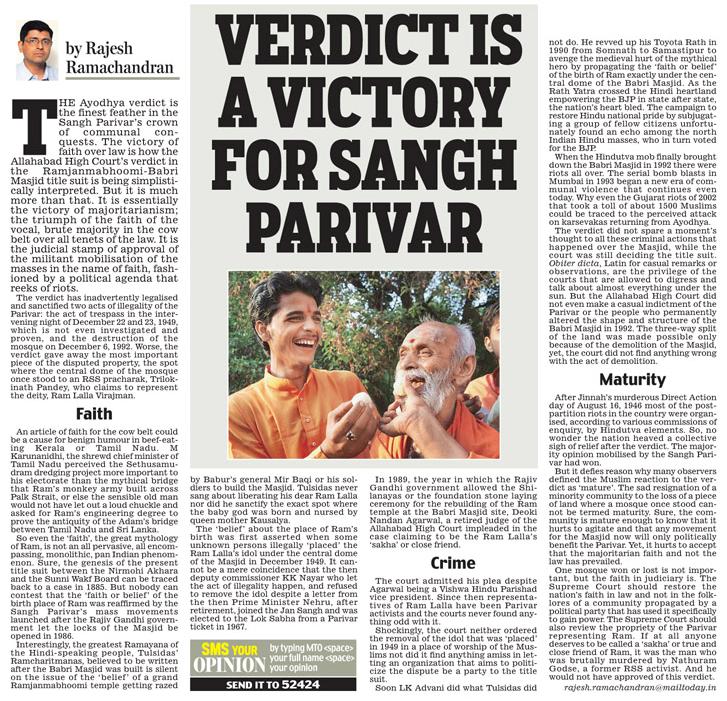
Verdict is Victory for Sangh Parivar


Mail Today Edit Page, October 13, 2010
THE Ayodhya verdict is the finest feather in the Sangh Parivar’s crown of communal conquests. The victory of faith over law is how the Allahabad High Court’s verdict in the Ramjanmabhoomi- Babri Masjid title suit is being simplistically interpreted. But it is much more than that. It is essentially the victory of majoritarianism; the triumph of the faith of the vocal, brute majority in the cow belt over all tenets of the law. It is the judicial stamp of approval of the militant mobilisation of the masses in the name of faith, fashioned by a political agenda that reeks of riots.
The verdict has inadvertently legalised and sanctified two acts of illegality of the Parivar: the act of trespass in the intervening night of December 22 and 23, 1949, which is not even investigated and proven, and the destruction of the mosque on December 6, 1992. Worse, the verdict gave away the most important piece of the disputed property, the spot where the central dome of the mosque once stood to an RSS pracharak, Trilokinath Pandey, who claims to represent the deity, Ram Lalla Virajman.

Faith

An article of faith for the cow belt could be a cause for benign humour in beef- eating Kerala or Tamil Nadu. M Karunanidhi, the shrewd chief minister of Tamil Nadu perceived the Sethusamudram dredging project more important to his electorate than the mythical bridge that Ram’s monkey army built across Palk Strait, or else the sensible old man would not have let out a loud chuckle and asked for Ram’s engineering degree to prove the antiquity of the Adam’s bridge between Tamil Nadu and Sri Lanka.
So even the ‘ faith’, the great mythology of Ram, is not an all pervasive, all encompassing, monolithic, pan Indian phenomenon. Sure, the genesis of the present title suit between the Nirmohi Akhara and the Sunni Wakf Board can be traced back to a case in 1885. But nobody can contest that the ‘ faith or belief’ of the birth place of Ram was reaffirmed by the Sangh Parivar’s mass movements launched after the Rajiv Gandhi government let the locks of the Masjid be opened in 1986.
Interestingly, the greatest Ramayana of the Hindi- speaking people, Tulsidas’ Ramcharitmanas, believed to be written after the Babri Masjid was built is silent on the issue of the ‘ belief ’ of a grand Ramjanmabhoomi temple getting razed by Babur’s general Mir Baqi or his soldiers to build the Masjid. Tulsidas never sang about liberating his dear Ram Lalla nor did he sanctify the exact spot where the baby god was born and nursed by queen mother Kausalya.
The ‘ belief’ about the place of Ram’s birth was first asserted when some unknown persons illegally ‘ placed’ the Ram Lalla’s idol under the central dome of the Masjid in December 1949. It cannot be a mere coincidence that the then deputy commissioner KK Nayar who let the act of illegality happen, and refused to remove the idol despite a letter from the then Prime Minister Nehru, after retirement, joined the Jan Sangh and was elected to the Lok Sabha from a Parivar ticket in 1967.
In 1989, the year in which the Rajiv Gandhi government allowed the Shilanayas or the foundation stone laying ceremony for the rebuilding of the Ram temple at the Babri Masjid site, Deoki Nandan Agarwal, a retired judge of the Allahabad High Court impleaded in the case claiming to be the Ram Lalla’s ‘ sakha’ or close friend.

Crime

The court admitted his plea despite Agarwal being a Vishwa Hindu Parishad vice president. Since then representatives of Ram Lalla have been Parivar activists and the courts never found anything odd with it.
Shockingly, the court neither ordered the removal of the idol that was ‘ placed’ in 1949 in a place of worship of the Muslims not did it find anything amiss in letting an organization that aims to politicize the dispute be a party to the title suit.
Soon LK Advani did what Tulsidas did not do. He revved up his Toyota Rath in 1990 from Somnath to Samastipur to avenge the medieval hurt of the mythical hero by propagating the ‘ faith or belief’ of the birth of Ram exactly under the central dome of the Babri Masjid. As the Rath Yatra crossed the Hindi heartland empowering the BJP in state after state, the nation’s heart bled. The campaign to restore Hindu national pride by subjugating a group of fellow citizens unfortunately found an echo among the north Indian Hindu masses, who in turn voted for the BJP. When the Hindutva mob finally brought down the Babri Masjid in 1992 there were riots all over. The serial bomb blasts in Mumbai in 1993 began a new era of communal violence that continues even today. Why even the Gujarat riots of 2002 that took a toll of about 1500 Muslims could be traced to the perceived attack on karsevakas returning from Ayodhya. The verdict did not spare a moment’s thought to all these criminal actions that happened over the Masjid, while the court was still deciding the title suit.
Obiter dicta , Latin for casual remarks or observations, are the privilege of the courts that are allowed to digress and talk about almost everything under the sun. But the Allahabad High Court did not even make a casual indictment of the Parivar or the people who permanently altered the shape and structure of the Babri Masjid in 1992. The three- way split of the land was made possible only because of the demolition of the Masjid, yet, the court did not find anything wrong with the act of demolition.

Maturity

After Jinnah’s murderous Direct Action day of August 16, 1946 most of the postpartition riots in the country were organised, according to various commissions of enquiry, by Hindutva elements. So, no wonder the nation heaved a collective sigh of relief after the verdict. The majority opinion mobilised by the Sangh Parivar had won.
But it defies reason why many observers defined the Muslim reaction to the verdict as ‘ mature’. The sad resignation of a minority community to the loss of a piece of land where a mosque once stood cannot be termed maturity. Sure, the community is mature enough to know that it hurts to agitate and that any movement for the Masjid now will only politically benefit the Parivar. Yet, it hurts to accept that the majoritarian faith and not the law has prevailed.
One mosque won or lost is not important, but the faith in judiciary is. The Supreme Court should restore the nation’s faith in law and not in the folklores of a community propagated by a political party that has used it specifically to gain power. The Supreme Court should also review the propriety of the Parivar representing Ram. If at all anyone deserves to be called a ‘ sakha’ or true and close friend of Ram, it was the man who was brutally murdered by Nathuram Godse, a former RSS activist. And he would not have approved of this verdict.
rajesh.ramachandran@mailtoday.in

Monday, July 5, 2010

Don’t go soft on Hindutva terror

by Rajesh Ramachandran
Mail Today, July 2, 2010
ALMOST two years after three blasts rocked three different states in the country, two of the cases remain unsolved. Only last week, the National Investigation Agency took over one of them. The common factor in all three attacks was the target: a Muslim neighbourhood.
History is only for scholars, the rest of us are brought up on folklores of the imagined past — of communities and even nations. All the country’s enemies or terrorists till now, in the chronological order of the insurgencies, have been Naga Christians, Khalistani Sikhs and Kashmiri Muslims. Now, of course, anyone with a Muslim name from Azamgarh or Kozhikode could be a terrorist. And, aimless bloodshed, mindless violence and targeted murders are all synonymous with radical Islam.
Meanwhile the mastermind of the first big terrorist attack in independent India, which killed the Father of the Nation, was honoured by an all party parliamentary committee. VD Savarkar’s portrait now mocks at Gandhi in Parliament’s Central Hall. Well, it is just a matter of detail that the Hindutva icon was let off only on technical grounds by the trial court and that a later commission of enquiry held him guilty of conspiring with Nathuram Godse and Narayan Apte to kill the Mahatma.
Bias
To cut to the chase, there seem to be two distinctly different yardsticks to investigate crimes by Islamist terrorists and Hindutva terrorists. The handbook of Indian investigators has only one set of suspects for bombings in mosques and Hindu neighbourhoods: hotheaded Muslim youth.
Hundreds of young Muslims from the ghettoes of the old city were rounded up when Hyderabad’s famed Mecca Masjid was bombed in May 2007. Their mothers had to hold candlelight vigils for the police to even admit that these youngsters were in their custody. Soon, some of them were let off and some others were officially arrested. The great Indian investigative tool, endless inhuman torture, could not solve the case.
Now, the Central Bureau of Investigation finds that the Mecca Masjid was bombed by the same people who had triggered the Ajmer blasts. At that time, names like Huji, HuM, LeT and JeM were bandied about by the Rajasthan police, only for the CBI to later discover that the Ajmer blast was orchestrated by Hindutva terrorists.
This amply demonstrated the communal bias of the police forces in various states. Just as an Islamist group could be suspected for attacking a Hindu religious congregation or a market place, there is reason to look for Hindutva leads into an attack on a Muslim neighbourhood or place of worship. But this logic seems to beat the Indian police.
Of the three bombs that went off in September 2008, the first attack was on Delhi’s Mehrauli locality on September 13. Even if the Delhi police claim that the target was not specifically a Muslim locality, the fact remains that the blast occurred very close to a mosque and that the other two attacks in Malegaon and Modasa, a fortnight later involving similar low intensity crude bombs, were clearly targeted at Muslim localities.
Despite Hemant Karkare, the brilliant investigator who unraveled the Hindutva terror network, cracking the Malegaon case in a matter of weeks, the Delhi police or the Gujarat police did not even seek the custody of the Hindutva terrorists.
The Modasa blast in Gujarat occurred on the same day as Malegaon, yet the many glaring similarities did not prompt the Gujarat government or the police to at least question the Malegaon accused.
Worse, Delhi police, answerable to the Congress government at the Centre, still do not want to talk to Pragya Thakur, Lt Colonel Purohit and the rest. In fact, a couple of years before the Mehrauli bombing, the country’s biggest and most magnificent mosque, the Jama Masjid, was targeted. The case remains forgotten and the Delhi police have still not considered the possibility that Hindutva terrorists could be behind it.
Credibility
Though Karkare had laid bare the Hindutva terror network restoring the Indian state’s credibility to a certain extent, his martyrdom during the Mumbai attack has caused irreparable damage to the investigation and the trial. The prosecution has ‘ forgotten’ to charge the accused with stricter provisions of the IPC like sedition and waging war against the country. While suspected Maoists are routinely charged under these sections, the prosecution’s lapse in the case of a group of people who sought to overthrow the Indian Constitution with the help of foreign forces betrays the Indian state’s communal bias.
It was indeed a relief to see the CBI finally joining the dots and carrying Karkare’s investigation forward and arresting Lokesh Sharma and Devender Gupta for the Ajmer blast. All it required all this while was a thorough investigation into the activities of the accomplices and contacts of the Malegaon accused, but BJP- ruled states like Gujarat, Madhya Pradesh and till recently Rajasthan refused to play ball.
After many years, what was suspected is being established — that the tentacles of the Malegaon accused are spread across the country and that they are responsible for a series of attacks including the Ajmer and Mecca Masjid blasts.
What suffered while Muslim men were arrested and beaten up for these very crimes without any solid evidence of their involvement was the Indian police’s credibility. But the police don’t seem to bother.
Maloy Krishna Dhar, the former joint director of the Intelligence Bureau in his book, Open Secrets claims that the curricula at the IB’s training centre “ had a distinct pro- Hindu bias.” Dhar an RSS activist in his youth, scarred by privations of the Partition, notes in his book that, “ A little later in my career I was surprised by the similarity of perception prevailing in the IB and the RSS.” For sure, IB cannot be compared with other police forces as it is not governed by a state government.
But the men and officers are chosen from the same pool. It is shocking that the nation’s internal security apparatus appointed a person like Dhar who professed the Hindutva ideology.
That too, when people with political affiliations like Communists were completely barred from entering even the central civil services.
State
The Constitution gives the monopoly of violence to the country’s armed forces and law enforcing agencies to ensure that it is upheld. But the law enforcing agencies appear to be soft on one section of terrorists who want to bring down the Constitution just as the other section of terrorists who is rightly punished.
Every arm of the state has its own logic; unfortunately the Indian police have retained a lot of colonial traits, which are often at variance with the people and the Constitution. The enemies of the people and the Constitution ought to be the enemies of the police. Any deviation from this basic principle, as manifested in the handling of riot cases and terror cases, ought to be addressed by the political leadership. Disciplinary action against all those officers who tried to link innocents to terror cases would be a good beginning to restore the Indian state’s credibility.
http://epaper.mailtoday.in/Details.aspx?boxid=479765&id=38666&issuedate=272010

Sunday, March 29, 2009

BJP never plays by the rules

Mail Today
March 28, 2009

THE puny little thing stuck into the mouth of a man in black running forward, backward and sideward, makes a match possible. Imagine football without the whistle. Every time the man blows the whistle, order is restored and rules enforced. In short, the whistle and its blower are symbols of fairness. Without the contraption, Zinedine Zidane and Marco Materazzi would have long ago been reduced to abusive, head- butting morons rather than enchanters weaving magic with their feet. Imagine cricket without the umpires upturned finger.

What the whistler is to sport, an Election Commission is to democracy, probably the greatest sport man ever invented. Election is a penalty shootout or sudden death where the referee ought to be more reflective than the shooter and the goalie. Then, this sport determines the fate of millions or even a billion, as in our case, and the winner rules the vanquished without drawing blood.

We, the largest democracy in the world, perhaps still have to come to terms with the referees whistle. As we do with the driving license, a traffic ticket or a defence deal, we try to fix even the Election Commission. Though our feudal instincts have not really worn out, 13 general elections and the defeat of Indira Gandhi and Sanjay Gandhi in 1977 have more or less proven that this match cannot be fixed yet.

History

But every party in power tries to subvert the Commission. Former deputy Prime Minister LK Advani got his home secretary to head the Commission. At least he did not have a non- governmental organization seeking money from BJP Parliamentarians or a dubious Emergency- era track record. The Congress brazenly pushed Navin Chawlas controversial appointment despite his apparent proximity to the ruling party.

But the Varun Gandhi episode exposes the inherent apathy of the saffron party towards the Constitution and the institutions it founded. The BJP fielded an old hack, Balbir Punj, to thumb his nose at the Commissions collective non- partisan decision on Varuns hate speech. After the fight in the Commission, the body was coming together as one and not as Advanis nominee and Congress nominee to plead with the principal Opposition party not to nominate Varun from Pilibhit. But the BJP did not even deliberate the decision for a day before Punj came out to remind the Commission of its jurisdiction.

Article 324 of the Constitution says that “ the superintendence, direction and control of election to be vested in an Election Commission.” So, in plain speak, the Commission decides how to hold an election. Article 325 says that, “ No person to be ineligible for inclusion in, or to claims to be included in a special, electoral roll on grounds of religion, race, caste or sex.” Sure, the Commission draws up the electoral rolls, but if a candidate or potential candidate threatens a community and insists that he doesnt want that communitys vote, does that not amount to disenfranchisement? Doesnt it amount to virtually obliterating the voting right of a group of people? Doesnt it mean that by virtue of being members of a community their votes do not count?

The Commission upholding its own best practices gave Varun Gandhi an opportunity to prove that the recording was doctored as he had been claiming. But instead of proving his innocence, his party insists on his candidature, that too when he has clearly violated not just the spirit of the Constitution but the letter of law.

Section 125 of the Representation of the People Act, 1951, seems to have be written with such venom- spewing politicians in mind: “ Promoting enmity between classes in connection with election — any person who in connection with an election under this Act promotes or attempts to promote on grounds of religion, race, caste, community or language, feelings or enmity or hatred, between different classes of the citizens of India shall be punishable with imprisonment for a term which may extend to three years, or with fine, or with both”. But the catch is that a candidate can be disqualified on these grounds ( which are, in fact an offence under the Indian Penal Code as well) only if he or she is convicted by a court for promoting enmity between two communities.

So, the BJP can celebrate Varun Gandhis candidature, get women- beating Sene leader Pramod Muthalik to campaign for him and even ask their veterans who were in jail during the Emergency to carry him around the country as the new Hindutva mascot. Not because Varun Gandhi has not violated a law, but his violation of the Indian Penal Code and the Representation of the People Act have to be proven in court, which is impossible within the next two months.

Endorsement

Now, the Commissions decision to ask the principal Opposition party poised to rule the country for a second term, not to consider Varun has been vindicated by the Allahabad High Court, which found prima facie case against the 29- year- old. Once a higher court establishes a prima facie case against a person, the trial court cannot obviously discharge him without a trial. But unfortunately, none of this would have a bearing on Varun Gandhi or his party.

The Sangh Parivar and its politicians never really admired Dr. BR Ambedkar or the Constitution he piloted. It is in fact sad that very few of the Parivar politicians where part of the Indian independence movement or the Constituent Assembly. Thus, to a large extent one could understand why the BJP wanted the Constitution to be reviewed when it set up a Constitution Review Committee as soon as the party came to lead a coalition government in 1998.

At one point or the other, the Parivars opportunistic politics has alternately hailed and abused Constitutional institutions. KR Narayanan, one of the best presidents in recent times who didnt write bad poetry, was extolled by the BJP when he refused to dismiss the BJP government led by Kalyan Singh. But when he applied the same standards for Mulayam, the same party found him wanting.

Indifference

The Comptroller and Auditor General of India is another body set up by the Constitution. The Parivar praised it to the heavens for the audit of the Bofors deal and the report TN Chaturvedi brought out. The BJP was so obliged to the Constitutional institution that the person who held the post was first nominated to the Rajya Sabha and then made a governor. But the same party when confronted with the Coffin Scam and the report on the Kargil purchases dismissed the CAG, saying that “ generals fight war, not comptroller general.” Later, one of its ministers called the CAG stupid when it audited the sale of Hotel Centaur by the NDA government.

Well, the BJP government in UP failing to uphold the orders of the greatest arbiter and guardian of the Constitution, the Supreme Court, in the Babri Masjid case only underlines the innate indifference to the rules of the game.

Every game has to be played according to some rules common to all the players. Either all candidates should be allowed to head- butt and call each other names. The Great Indian Electoral Circus would be more colouful and more close to ground, if they all begin abusing each other and threatening the other with sterilization. After all, poor Varun was talking about his sole legacy, his fathers forced sterilization drive.

Sunday, October 12, 2008

Sangh's tribal face threatens more riots

Not over yet says RSS tribal face

By Rajesh Ramachandran in Kandhamal
MAIL TODAY October 10, 2008

TRIBAL leader Lambodar Kanhars house is heavily guarded by the state, which still cannot ensure safe passage to tens of thousands of Dalit Christians who desperately want to return home.

Kanhar is widely alleged to have led the December 2007 riots against Panos, the Dalits and many victims claim he led the mob this time too. But the administration insists that he was not arrested along with the 500 tribal and Sangh Parivar activists because he was somehow not involved in the riots that began on August 24.

Yet, with the police guarding him, Kanhar threatens another round of riots, if his demands are not met. “ We will wait for one more month. If our demands are not met by then, there will be riots again. These riots are spontaneous and are very effective because they are for the tribal cause,” explains Kanhar nonchalantly.

He refutes all accusations of Sangh Parivar involvement, feigns complete ignorance of the presence of RSS leaders like Ajit Mahapatra in the district when Dalits were raped, murdered and their houses systematically torched and he asserts that the riots here were not anti- Christian.

He leans on his chair and effortlessly echoes the “ earth shakes when big trees fall” logic: “ If my father is killed wont my siblings get together to seek revenge? That is what happened here.

Pano Christians among the Maoists have killed our guru, Lakshmanananda Saraswati. Christians had a meeting with the Maoists to plot the murder. Otherwise why should the Maoists kill Swami ji ? He had no enmity with the Maoists, he was only obstructing conversion and preventing cow slaughter.” According to this Kui Samaj coordination committee secretary, his is only an ethnic fight for rights. And Kanhars prescription for peace is a role reversal: “ The Panos served us faithfully, tilled our land, tended to our cattle and gifted men for our human sacrifice. But over the years they grabbed our land, stole our girls and our due in government jobs with fake tribe certificates. Peace can be restored only if our demands for restoration of land, investigation into fake caste certificates and removal of those with such certificates from government jobs are met.” In other words, he wants to resubjugate the Panos.

The contradictions here are largely between an imagined glorious past and an impoverished present. Panos were the underdogs for far too long and like most underdogs were enterprising. They grabbed the first opportunity that conversion to Christianity presented them to shake off the shackles of the past. In a state where untouchability is widely practiced even in tribal areas, Panos were liberated from the Kandha serfdom and also untouchability by the new faith.

Then, competing Christian missionaries brought relative prosperity, some political muscle in the Dalit reserved constituency and also education, health, jobs and a better life.

But Kandhas comprising over 50 per cent of the districts population remained backward. For them, a Pano wearing shirt- pants, buying land, landing jobs and their children zooming in and out of the village in new two- wheelers were all instances of “ exploitation”. No doubt, some Pano politicians by demanding tribe status for Dalits on the grounds that both speak the same Kui language fuelled this strife. They had their eyes set on land and jobs, probably.

But, the ethnic conflict cannot be ignored. After all, the first widely reported riot was in 1982 and the next one in 1994.

Then, the Sangh Parivars dramatic entry into the scene only exacerbated the divide, changing the contours of the conflict. Whether Kanhar likes it or not, many Kandha Christians too have been raped, murdered and left homeless.

Christian refugees flee Orissa

Fear turns Orissa refugees into migrants

By Rajesh Ramachandran in Kandhamal
MAIL TODAY October 9, 2008

HATRED and the misery it begets seem to have travelled the breadth of the country from Gujarat to Orissa.
Riots here have become comparable in their terrible scale of suffering to those of Gujarat because of the sheer number of the homeless and their migration.
Over 27,000 people are refugees in just one district.
Many more are missing in the forests. Worse, despite the governments claims of normalcy, they are not returning home, but are fleeing the district and even the state.
At the peak of the riots that began on August 24, there were 17 relief camps housing 27,000 people. Now there are 10 with around 13,000 refugees.
But the figures fail to tell the tale of migration. Those who are leaving the camps are not going home as the administration insists. Some may have returned, but the overwhelming majority is seeking safety.
There is a steady stream of Dalit Christians reaching the state capital, Bhubaneswar, only to flee further from fear.
Their houses have been looted, flattened and in some cases, the rains have erased all traces of habitation.
Even a conversion to the Sangh Parivar brand of Hinduism, a pre- requisite to step back into the village, is no guarantee for life and land.
According to those who run the relief camps, there are few cases of families returning to their villages. “ They are going to Kerala, Goa, Surat, Bangalore, Pune and elsewhere. It is a lie that they are going home.
Those who have relatives in Bhubaneswar stay there while those who have been working in other states are taking away their families to their workplaces.
There are many from Kandhamal who are working in Kerala, in the textile mills of Surat and elsewhere,” said a relief worker who didnt want to be identified.
In a desperately poor milieu, many Dalit Christians are the educated rural middle class.
Theirs has been a descent from decent living to destitution.
From pucca houses to cramped tents, most of them like Asya Digal at the Vijaya camp in Raikia look distracted.
His glassy gaze hides his proud past and the present pain of loss. Once a farmer who
fed his family and a skilled mason who had a three- bedroom pucca house, Asya now shares his tent with his grownup daughters.
At the G. Udaigiri camp, Jana Naik was ashamed to talk. He retired from the Army, his wife is a government school teacher and they had enough land to have never bought rice.
The murder of two of his cousins by the rioters drove him first into the forests and then into the camp.
“ I will not go anywhere. How can I go? What will happen to my standing crop and my land?” He refused to be photographed.
Unlike Naik, Dilip Pradhan is a tribal Christian whose family got stranded in the crossroads of the ethno- communal strife.
Ethnically, he ought to be with the arsonists but his faith sent him to the relief camp.
He works at Thrissur in Kerala and desperately hopes that the government will help his family go back to the village because he cant afford to shift them.
But nobody, neither the state nor the central government, has instilled any hope of home for Kandhamals refugees.

MEN BEHIND ORISSA RIOTS EXPOSED


Victims point finger at key RSS functionary and local BJP MLA

Rajesh Ramachandran reports from violence- torn Kandhamal
MAIL TODAY October 8, 2008


Masterminds of Orissa riots

RIOTS ARE seldom spontaneous. Here too, they were meticulously planned, organised and executed allegedly by the Sangh Parivar and helped in no small measure by local authorities who refused to raise a finger. On August 24, Parivar activists had a free run, leaving at least 27,000 homeless, 38 dead and forcing hundreds or even thousands to still live in fear in the jungles.

Every such strife needs a mastermind. Many victims here allege that Ajit Mahapatra, RSS joint organising secretary for Orissa, West Bengal and Sikkim, had camped at Kandhamal and apparently had a hand in planning and executing the waves of strikes on Dalit Christians. But unlike in many such attacks — where police quickly arrest the masterminds and name the organisations — here superintendent of police Praveen Kumar says he hasnt a clue to who the conspirators were. He insists he is in no position to name any person or organisation.

This, after one-and-a-half months of rioting and arson. Kumar pleads nobody has told him about the key conspirator. “I cant say who masterminded it. To establish a conspiracy, according to the law, we should know about the meetings that took place. But nobody has come forward to give any such evidence.”

Gauri Prasad Rath, VHPs general secretary, rubbished the allegation against Mahapatra. Speaking on behalf of Mahapatra, he said: “These charges dont hold water. The riots started immediately after Swami Lakshmananand Saraswatis murder. Mahapatra is in charge of such a vast area. How could he be involved,” Rath asked. Police say 500 locals, including the 100 Parivar activists, are in preventive detention. But some of the key conspirators have fled. “Karendra Majhi, the local BJP MLA, and Mahapatra are the real conspirators and the police are mute spectators,” claims a victim who was attacked by Sangh activists and fears reprisal for naming the central actors.

Majhi, though, protested his innocence. “I am a politician. What role can I have in these riots? The people have done all this.” Though most of the key planners have cleared out of the scene of crime, the conspirators have left behind enough footprints for the police — thats if theyre serious about getting to the bottom of the case. MAIL TODAY pieced together the victims accounts of a premeditated attack on the Dalits of Kandhamal.

Preparations for the riots began immediately after Maoistsgunned down senior VHP leader Lakshmananand Saraswati on August 23. The next few weeks saw systematic attempts to cleanse the district of its Dalits who had converted to Christianity. Trees were cut and boulders piled up on roads to block any police interference. Saffron flags were hoisted in many places like G Udaygiri and Raikia to identify Hindu homes and shops so that the mob knew where to strike and where not to.

The procession carrying the slain leaders body is said to have taken a route dotted with churches and Dalit pockets, leaving in its wake death and destruction. As the procession went past a particular point, the activists blocked access and descended on the Dalits with full force, eyewitnesses recall. “Even in Bhubaneswar, on August 25 — the day VHP gave a bandh call — the local Durga Vahini leader came with a list of prominent Christian institutions such as Xaviers Institute of Mangement and Loyola School. Somehow, no major harm was done to them. “I came here only on September 9, but I am told that the Parivar leaders kept the body of Lakshmananand in front of the churches exhorting their activists to destroy the shrine,” claims Tony Raj, a Jesuit priest attending to refugees in the largest relief camp of Raikia. Police were not very keen to stop the rioters. While all this was on, around 40 officials who were made executive magistrates to order police firing at the mobs, were safely ensconced in police stations.

The real kingpins stayed behind, remote controlling the Kandha tribals who indulged in arson, loot, rape, murder and forced re-conversion so that the longstanding ethnic conflict between the Kandha tribes and Pana Dalits subsumed the Sangh Parivars involvement. The traders association, among others, collected money to fund the campaign and feed the families of the arrested Parivar activists.

There couldnt be a better testimony to official apathy than the happenings at Phulbani, the district headquarters. Here, the Orissa Baptist Church was torched at 11 in the morning in the presence of 12 Orissa Special Armed Police personnel, alleges Aroop Jena, a local journalist and the district convener of the All-India Christian Council. “The executive magistrates werescared and didnt want to step out. The police could have stopped big incidents in Udayagiri, Raikia and Tikabali and many other places,” said Jena, whose house too was attacked.

The then SP was suspended and the new one joined some time after the riots. He reminds that there were three incidents of firing. But that wasnt enough to deter the Parivar activists determined to drive the Dalit Christians out of their homes. “Enough force was not available. Handling these riots is a challenging task because of the difficult terrain. The forests severely limit mobility,” Kumar said. But the CRPFs intensive patrolling has brought the situation under control now.

Police have cracked down on the Kandha tribal leadership as well. But the tribals deny a Sangh Parivar purge. For Lambodar Kanhar, the Kui Samaj Coordination Committee secretary, the riot was a simple ethnic conflict between his tribe and the Dalits who have been their exploiters.

rajesh.ramachandran @mailtoday.in